How AEO works vs SEO, GEO & AIO

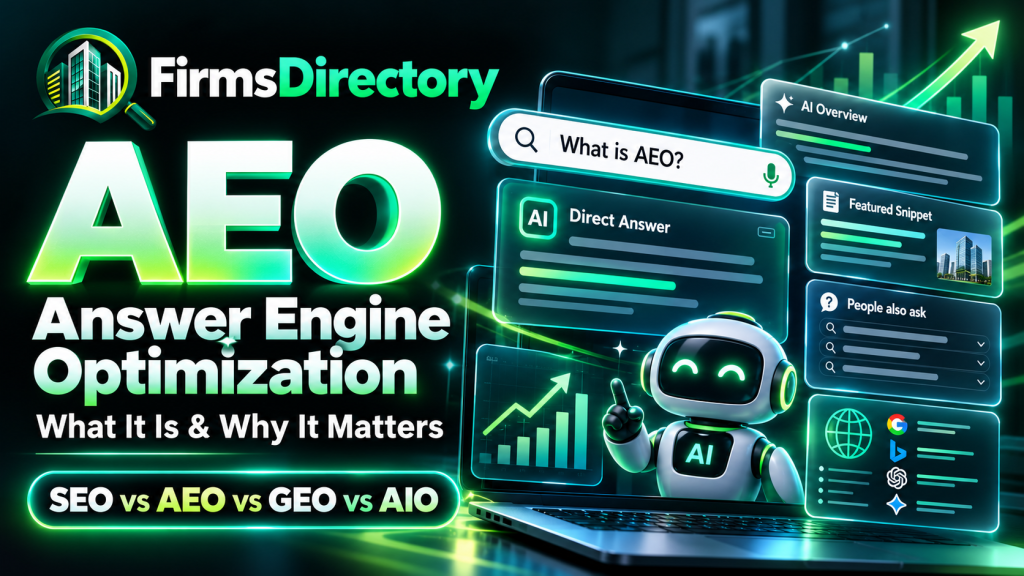
What Is AEO? Answer Engine Optimization Explained, Benefits, Examples, and How It Works
AEO stands for Answer Engine Optimization, a digital marketing approach focused on making information easier for answer engines and AI-powered search systems to discover, understand, and use when answering questions. It builds on traditional SEO practices while emphasizing clear explanations, factual accuracy, and content that directly addresses what people want to know.
The way people search for information online is evolving. Instead of browsing several webpages to find an answer, users can now ask questions through AI-powered search experiences, virtual assistants, and other answer-oriented systems.
For example, someone might ask an AI assistant, “What is the best project management software for a small business?” Rather than presenting only a list of webpages, the system may produce a summary explaining several options and linking to supporting sources.
This shift has increased interest in AEO marketing and how businesses can make their content more useful for direct answers.
But does AEO replace Search Engine Optimization? Is AEO the same as Generative Engine Optimization? Can small businesses implement it without hiring specialists?
This educational guide explains what AEO means, how Answer Engine Optimization works, why it matters, its benefits, practical implementation steps, and the differences between SEO, AEO, GEO, and AIO.
What Is AEO (Answer Engine Optimization)?
Answer Engine Optimization, commonly abbreviated as AEO, refers to practices intended to make digital information more useful and accessible to systems that provide direct answers to user questions.
These systems may include AI-powered search experiences, search engine answer features, and conversational assistants that retrieve information from websites.
Traditional search optimization has often focused on improving how webpages appear within search results.
AEO emphasizes a related objective: helping content answer questions clearly enough that a search or answer system can identify useful information.
A Simple AEO Example
Imagine a business offering appointment scheduling software.
A potential customer asks:
“What is appointment scheduling software?”
A vague company website might describe its product as an innovative digital solution that revolutionizes productivity.
However, this description does not directly answer the question.
A more informative explanation would be:
“Appointment scheduling software is a digital tool that allows businesses and customers to book, manage, reschedule, and cancel appointments through an online calendar.”
The second explanation is clear, factual, and useful to someone learning about appointment scheduling.
It also provides information that a search-enabled answer system could potentially retrieve when researching the topic.
This illustrates the purpose of AEO: provide genuinely useful answers rather than relying solely on promotional language.
Is AEO a Separate Search Engine Ranking System?
No. AEO is an industry term rather than a universally standardized ranking system.
Different search platforms use different methods for retrieving information and generating answers.
Google’s official documentation explains that its generative AI search experiences continue to rely on foundational SEO principles.
Google does not require a separate AEO-specific markup format or special AI schema for inclusion in AI Overviews or AI Mode.
For businesses, the practical objective is to create useful, accurate, accessible information that supports both traditional search and AI-powered discovery.
What Is AEO in AI?
In artificial intelligence and digital marketing, AEO means Answer Engine Optimization.
It refers to improving the quality and accessibility of information that AI-powered systems may use when answering questions.
Some AI assistants can search the internet and retrieve webpages before generating responses.
Other responses may rely partly on information learned during model training.
This distinction matters because making a webpage useful for AI search does not mean permanently teaching an AI model to remember a business.
How AI-Powered Answer Systems Use Information
Consider a user asking:
“How does customer relationship management software help a sales team?”
A search-enabled AI system may retrieve relevant webpages explaining customer databases, lead tracking, sales pipelines, reporting, and related software features.
It may then generate a response summarizing the information and, depending on the platform, cite selected sources.
Webpages containing accurate explanations of these subjects can potentially contribute useful information.
However, AI systems do not necessarily retrieve the same sources for every question.
The quality, relevance, accessibility, and freshness of information can affect which sources are useful.
Does AEO Guarantee AI Recommendations?
No. Implementing AEO does not guarantee that ChatGPT, Google AI Mode, Microsoft Copilot, or another AI system will recommend or cite a website.
AI systems determine which information to use according to their own retrieval and response-generation processes.
AEO should be treated as a strategy for improving content quality and discoverability, not as a guaranteed method for controlling AI-generated answers.
How Does Answer Engine Optimization Work?
AEO involves creating information that directly addresses questions while ensuring the content is accessible and appropriately organized.
The process can be understood through several practical elements.
1. Understanding User Questions
People often search using specific questions rather than isolated keywords.
For example:
- What is email marketing?
- How does payroll automation work?
- What is the difference between CRM and ERP software?
- How much does project management software cost?
- Which accounting features does a small business need?
Understanding these questions helps businesses create information that matches actual customer needs.
2. Providing Direct Answers
A useful answer usually explains the subject without requiring readers to interpret vague promotional statements.
For example, a page discussing payroll software should clearly describe what payroll software does before introducing advanced technical concepts.
This benefits human readers and may make the information easier for search systems to interpret.
3. Adding Supporting Context
Short answers can be useful, but complicated topics often require additional explanations.
A guide about accounting software might explain its primary purpose, common features, limitations, and different applications.
The objective is not to publish only short paragraphs.
It is to provide the right amount of information for the question being answered.
4. Organizing Content Logically
Descriptive headings, readable paragraphs, comparison tables, and meaningful links can make content easier to navigate.
Clear organization helps visitors find information quickly.
It also makes important sections easier for automated systems to interpret.
5. Maintaining Technical Accessibility
Important information should be accessible to appropriate search crawlers.
Unintentionally blocking pages, using incorrect indexing controls, or hiding essential information behind inaccessible interfaces can limit discoverability.
Technical SEO remains part of an effective AEO strategy.
What Is AEO vs SEO?
SEO stands for Search Engine Optimization, while AEO stands for Answer Engine Optimization.
SEO generally focuses on improving a website’s visibility within organic search results.
AEO emphasizes making information useful for systems that directly answer questions.
These approaches overlap significantly because useful answers can also support traditional search performance.
| Factor | SEO | AEO |
|---|---|---|
| Full Meaning | Search Engine Optimization | Answer Engine Optimization |
| Primary Emphasis | Organic search visibility | Useful information for direct answers |
| Content Approach | Search intent, relevant content, and site optimization | Clear answers, factual explanations, and context |
| Technical Foundation | Crawlability, indexing, usability, and links | Many of the same SEO fundamentals |
| Potential Outcomes | Search impressions, clicks, and conversions | Answer visibility, citations, and qualified discovery |
| Guaranteed Results | No | No |
Can SEO and AEO Work Together?
Yes. Businesses can support both strategies by creating accurate content that answers relevant questions while following established SEO practices.
For example, an educational guide about customer relationship management software can target relevant search queries and provide clear explanations that answer common customer questions.
The same resource may be useful to visitors arriving from traditional search results and to systems retrieving information for direct answers.
Rather than treating AEO as a replacement for SEO, it is more useful to think of it as an overlapping approach to content discoverability.
SEO vs AEO vs GEO vs AIO: What’s the Difference?
As artificial intelligence becomes more integrated into online discovery, several optimization terms have become popular in digital marketing.
These include SEO, AEO, GEO, and AIO.
Although the terminology can make them appear completely separate, the underlying practices often overlap.
| Term | Meaning | Main Focus |
|---|---|---|
| SEO | Search Engine Optimization | Organic search discoverability and performance |
| AEO | Answer Engine Optimization | Making content useful for direct answers |
| GEO | Generative Engine Optimization | Visibility in AI-generated responses and citations |
| AIO | Often AI Optimization or Artificial Intelligence Optimization | A broader, inconsistently defined term for AI-related optimization |
What Is GEO?
Generative Engine Optimization, or GEO, refers to efforts aimed at improving the visibility of content, brands, or businesses within responses generated by AI systems.
For example, a marketing company may want its educational research cited in an AI-generated comparison of digital advertising strategies.
GEO can involve content quality, accurate information, useful research, and relevant public references.
However, no universal GEO ranking formula applies to every AI platform.
What Is AIO?
AIO is a less standardized abbreviation.
In digital marketing discussions, it may mean AI Optimization or Artificial Intelligence Optimization.
Some marketers use it broadly when discussing improvements intended for AI-powered discovery, while others use the term for applying AI tools to marketing workflows.
Because AIO does not have one universally accepted definition, readers should check how the term is being used in a particular article or service.
Where Does Entity SEO Fit?
Entity SEO focuses on clarifying the identities and relationships of recognizable subjects such as businesses, products, organizations, and brands.
Clear information about an organization and its services can complement SEO, AEO, and GEO.
For example, accurately identifying a software company, its official website, and its products may help visitors and search systems distinguish that business from similarly named organizations.
The most practical strategy is to maintain a clear digital identity while publishing informative, relevant content.
Why Answer Engine Optimization Matters for Online Success
AEO matters because the ways people find information are changing.
Many users now expect direct explanations instead of manually reading multiple webpages to discover basic facts.
AI-powered systems make this type of interaction possible for a growing range of questions.
Consumers Ask More Detailed Questions
Instead of searching only for “accounting software,” someone might ask:
“What accounting software features should a small business look for before choosing a platform?”
This question expresses a specific informational need.
A useful article can answer that question by explaining invoicing, expense tracking, financial reporting, integrations, and other relevant features.
Business Discovery Includes More Than Search Rankings
A company may be discovered through a traditional search result, a business directory profile, an industry article, or an AI-generated response.
This makes information quality important across multiple channels.
Direct Answers Can Influence Customer Research
When users receive useful explanations, they may better understand their options before making purchasing decisions.
Companies that publish reliable information can contribute to the research process.
However, appearing as a cited source does not guarantee a customer visit or purchase.
AEO Encourages Better Educational Content
Writing for specific user questions can encourage businesses to explain their services more clearly.
This has practical value even when an AI platform never cites the page.
Visitors are more likely to understand a business when its website answers relevant questions directly and accurately.
What Are the Benefits of AEO?
Answer Engine Optimization offers several potential benefits when integrated with a broader content and SEO strategy.
1. Clearer Communication
Question-focused content encourages businesses to explain products, services, and industry concepts in straightforward language.
This makes information more accessible to potential customers.
2. Better Alignment with Search Intent
AEO encourages publishers to consider the actual questions people ask.
This can help produce content that is more closely aligned with user needs.
3. Potential Visibility in Answer-Oriented Experiences
Informative webpages may be considered by search-enabled systems retrieving information for direct answers.
However, inclusion and citations are not guaranteed.
4. Improved Customer Education
Educational content can help visitors understand complex products before contacting a company.
For example, a software provider can explain implementation requirements, compatibility, and common use cases.
5. Stronger Content Organization
Clear headings, topic relationships, and relevant internal links can improve website usability.
6. Support for Traditional SEO
Content that accurately answers relevant questions may also support a website’s broader organic search strategy.
7. More Informed Business Inquiries
When customers understand the services a company offers, their inquiries may become more specific and relevant.
However, whether this improves conversion rates depends on many factors, including the product, audience, and customer experience.
8. Long-Term Information Value
Useful guides, definitions, and product explanations may remain relevant over time.
Regular updates can help maintain their accuracy as industries and technologies change.
What Is AEO Marketing?
AEO marketing is the application of Answer Engine Optimization principles within a business’s broader digital marketing strategy.
The objective is to create useful information that helps potential customers research products, services, and relevant subjects through question-answering experiences.
AEO for Software Companies
Software businesses can publish documentation, feature explanations, product comparisons, and tutorials.
For example, a project management software company could explain how task dependencies work or which collaboration features different teams need.
AEO for Professional Service Providers
Consultants, agencies, and other service providers can answer frequently asked questions about their work.
A digital marketing agency might publish educational guides about SEO audits, conversion optimization, content strategies, and campaign measurement.
Readers researching specialized search services can also explore the SEO Agencies company tag on FirmsDirectory to discover businesses offering related services.
AEO for Ecommerce Businesses
Online stores can provide detailed product specifications, comparison guides, usage instructions, and accurate information about product compatibility.
For example, a retailer selling ergonomic office chairs could explain different adjustment mechanisms and how to select a suitable chair.
AEO for Educational Businesses
Education providers can answer questions about course requirements, teaching methods, program structures, and learning outcomes.
This helps prospective learners understand the educational options available.
Visitors researching these providers can also explore organizations in the Education industry directory.
AEO and Content Marketing
AEO works well with educational content marketing because both emphasize providing information that addresses user needs.
A business can combine articles, tutorials, documentation, and comparison guides to explain its products and related subjects.
However, publishing large quantities of generic content does not guarantee better search or AI visibility.
How to Implement AEO: A Beginner’s Step-by-Step Guide
Businesses can begin implementing AEO by improving the clarity and usefulness of their existing content.
Advanced AI tools are not required to complete many foundational improvements.
Step 1: Identify Customer Questions
Start by collecting questions that customers regularly ask about your business, products, and industry.
Possible sources include customer support inquiries, product demonstrations, sales conversations, and existing search performance data.
For example, a company providing CRM software might identify questions about implementation, integrations, customer records, and pricing.
Step 2: Match Questions to Search Intent
Not every question has the same purpose.
Some users want basic explanations, while others are evaluating products or seeking instructions.
Examples include:
- Informational: What is a CRM system?
- Comparative: CRM vs ERP: What is the difference?
- Instructional: How do I import contacts into CRM software?
- Commercial research: What CRM features should a startup compare?
Understanding the question helps determine the appropriate content format.
Step 3: Write Clear, Direct Explanations
Provide a useful answer near the beginning of the relevant section.
Then expand with supporting details, examples, and qualifications.
For complicated topics, explain important limitations rather than presenting an oversimplified answer.
Step 4: Create Detailed Supporting Content
A direct answer should not be the only information on a webpage when readers need additional context.
For example, a definition of marketing automation can be followed by explanations of common workflows, practical examples, and limitations.
The objective is comprehensive usefulness, not simply minimizing word count.
Step 5: Use Descriptive Headings
Headings should accurately describe the information beneath them.
Question-based headings can be useful when they match genuine reader questions.
However, publishers should avoid repeating nearly identical questions solely to target keyword variations.
Step 6: Improve Internal Linking
Connect related educational resources when doing so helps the reader.
For example, an article introducing AEO may naturally connect to a deeper explanation of how search engines understand brands and entities.
Internal links help visitors navigate and allow search crawlers to discover related webpages.
Step 7: Make Important Content Accessible
Ensure essential information is available as readable webpage text.
Review website indexing settings, server restrictions, internal navigation, and other technical conditions that may affect search crawler access.
Google explains that webpages must meet its search eligibility requirements before they can appear as supporting links in AI search features.
Step 8: Use Appropriate Structured Data
Structured data can help search engines interpret specific types of webpage information.
For example, BlogPosting or Article structured data can describe educational articles, while BreadcrumbList can represent a page’s navigational position.
Structured data must accurately reflect the webpage’s visible content.
Google does not require special AEO-specific schema to appear in AI Overviews or AI Mode.
Step 9: Support Claims with Reliable Information
When discussing technical processes, research findings, or other important factual claims, provide reliable supporting evidence.
Useful examples, accurate product specifications, and links to authoritative documentation can strengthen the educational value of a page.
Step 10: Review and Update Content
Information about technology, regulations, software, and other changing subjects may become outdated.
Review important articles periodically and correct information that is no longer accurate.
Step 11: Monitor Search and AI Visibility
Use Google Search Console, Bing Webmaster Tools, website analytics, and other relevant reporting tools.
Evaluate whether informational improvements are associated with changes in visibility, referrals, customer inquiries, and other meaningful outcomes.
Do not assume that every change in AI citations was caused by one content update.
Practical Answer Engine Optimization Examples
The following examples illustrate how businesses can apply AEO principles.
Example 1: An Accounting Software Company
Customer question: “What is automated invoice processing?”
Weak answer: “Our innovative solutions revolutionize financial productivity.”
More informative answer:
“Automated invoice processing uses software to capture invoice information, organize approval workflows, and transfer relevant data into accounting systems with less manual entry.”
The improved answer explains the concept rather than relying on promotional language.
Example 2: A Marketing Agency
Customer question: “What is the difference between SEO and paid search advertising?”
The agency could explain how organic search results differ from paid advertisements and discuss the tradeoffs involved in each approach.
A comparison table could help readers understand factors such as advertising budgets, campaign timing, and long-term content investment.
Example 3: An Ecommerce Store
Customer question: “What is the difference between mechanical and membrane keyboards?”
The online store could explain how the keyboard mechanisms operate, compare their characteristics, and discuss which features different users may prioritize.
Accurate explanations may help customers evaluate products more confidently.
Example 4: A SaaS Business
Customer question: “Can project management software integrate with email?”
A useful response should identify the specific integrations the software supports, explain any requirements, and acknowledge limitations.
Inventing compatibility or making unsupported claims would undermine the usefulness of the answer.
What These AEO Examples Have in Common
Each example focuses on clearly answering an actual question.
The objective is to provide information that visitors can use when learning about a topic or evaluating a product.
These improvements make content more useful regardless of whether an AI system eventually cites it.
Can Business Directories Support AEO?
Business directories can contribute to answer-oriented discoverability by publishing accurate descriptions of companies, their services, and their official websites.
For example, an AI-powered search system researching software providers may encounter public directory profiles alongside official websites and other resources.
A detailed company profile may contain relevant information about products, services, or business specialization.
However, the system may choose to retrieve or cite other sources instead.
Clear Business Descriptions
A company directory profile should explain what a business actually offers.
For example, a business offering customer support automation software should describe the relevant software capabilities instead of using vague marketing claims.
Relevant Industry Classification
Industry categories help visitors discover companies involved in related business activities.
They also provide context about the type of organization represented in a directory.
Specialized Company Tags
Company tags can provide more focused information about a company’s area of specialization.
For example, the AI Marketing Tools company tag groups businesses associated with artificial intelligence applications in marketing.
This type of categorization can help readers explore relevant providers based on the services or technologies they are researching.
Accurate Official Website Links
Directory profiles can provide a direct path from a company’s public profile to its official website.
This allows visitors to confirm important details using the company’s own resources.
Can Directories Guarantee AI Search Citations?
No. A directory listing does not guarantee inclusion in AI-generated responses.
Creating numerous low-quality directory links primarily to influence rankings is also not a reliable AEO or SEO strategy.
Businesses should prioritize legitimate, relevant platforms and accurate business information.
Creating a Business Profile on FirmsDirectory
FirmsDirectory is a business discovery platform that organizes public company profiles by industry and relevant specialties.
Businesses interested in presenting their information to potential customers can learn more through the free website submission page.
Creating a directory profile can complement a company’s official website and broader online presence, but it does not guarantee search rankings, AI citations, or customer inquiries.
How to Measure AEO Results and Performance
Measuring Answer Engine Optimization results requires distinguishing between different kinds of visibility.
An AI citation, business mention, search click, and customer conversion represent different outcomes.
1. Search Performance
Google Search Console provides data about how webpages perform in Google Search.
Website owners can review impressions, clicks, and relevant search performance reporting.
Google has also introduced reporting specifically for generative AI search experiences.
2. AI Search Citations
Bing Webmaster Tools provides AI Performance reporting that helps website owners understand citation activity across supported Microsoft AI experiences.
Available information may include cited pages, citation trends, and related grounding queries.
A citation means content was referenced. It does not necessarily indicate that a user clicked the link.
3. Referral Traffic
Website analytics can help identify traffic referred by recognizable external sources.
However, not every visit associated with an AI recommendation can be identified reliably.
4. Brand Mentions
Businesses may monitor whether AI systems mention their brands for relevant questions.
These observations should be treated carefully because generated responses can vary across systems, sessions, and query wording.
5. Customer Conversions
Qualified inquiries, product registrations, and purchases provide additional information about business results.
These metrics help distinguish online visibility from meaningful commercial performance.
Understanding AEO Results
| Metric | What It Indicates | Main Limitation |
|---|---|---|
| Search Impressions | Visibility in eligible reported search results | Does not guarantee a click |
| AI Citations | Content referenced in supported AI answers | Not equivalent to recommendations or traffic |
| Referral Visits | Visitors arriving through identifiable referring sources | Some discovery paths may be difficult to attribute |
| Brand Mentions | Appearance of a brand within observed responses | Results can vary by prompt and system |
| Conversions | Business actions completed by visitors | Requires appropriate tracking and attribution |
Businesses should evaluate these indicators together rather than relying on a single AEO visibility score.
Common AEO Mistakes to Avoid
Believing AEO Replaces SEO
Traditional SEO practices remain important, particularly for search systems that retrieve information from indexed webpages.
Writing Only for AI Systems
Content should primarily help actual readers.
Artificially writing paragraphs solely to influence AI responses can reduce readability and usefulness.
Creating Excessive FAQ Pages
Publishing hundreds of repetitive question-and-answer pages does not guarantee visibility.
Related questions can often be answered more effectively within a comprehensive educational article.
Publishing Unsupported Claims
Incorrect product information, invented statistics, and misleading comparisons can undermine trust.
Important claims should be accurate and appropriately supported.
Assuming Schema Guarantees AI Visibility
Structured data can help describe webpage content but does not guarantee AI recommendations, citations, or rankings.
Ignoring Content Maintenance
Outdated service descriptions, pricing information, and technical documentation can mislead readers.
Content should be reviewed when important facts change.
Confusing Citations with Customers
An AI citation is not necessarily a website visit, lead, or sale.
Businesses should evaluate actual outcomes alongside visibility indicators.
What Does AEO Stand for in Education?
In education, the acronym AEO can have meanings that are unrelated to Answer Engine Optimization.
The correct interpretation depends on the country, educational institution, and administrative context.
For example, the New South Wales Department of Education in Australia uses AEO to mean Aboriginal Education Officer, a role that supports students, families, teachers, and educational engagement.
In some other educational administrative contexts, AEO can refer to an Assistant Education Officer or Assistant Educational Officer.
These educational meanings are different from AEO in digital marketing.
If you encounter the abbreviation in a school document, job description, or education policy, check the terminology used by the relevant institution.
In the context of this article, AEO means Answer Engine Optimization.
Frequently Asked Questions About AEO
What does AEO mean?
In digital marketing, AEO stands for Answer Engine Optimization. It refers to practices intended to make online information more useful for systems that directly answer user questions. The abbreviation may have other meanings in unrelated industries.
What is AEO vs SEO?
SEO stands for Search Engine Optimization and emphasizes organic search visibility. AEO stands for Answer Engine Optimization and focuses on making information useful for direct answers. The two approaches overlap and share important content and technical foundations.
What is AEO in AI?
In AI search and digital marketing, AEO refers to improving content so AI-powered answer systems can potentially discover, understand, and use relevant information. It does not guarantee AI citations or recommendations.
What is AEO and why does it matter?
AEO is Answer Engine Optimization. It matters because more people use search and AI systems that provide direct answers. Clear, accurate, and accessible content can help users understand subjects and may support visibility across different discovery experiences.
What does AEO stand for in education?
AEO has different meanings in education depending on the context. For example, it can mean Aboriginal Education Officer in New South Wales, Australia, or Assistant Education Officer in certain other educational systems. It does not necessarily mean Answer Engine Optimization.
Why is Answer Engine Optimization important for online success?
Answer Engine Optimization encourages businesses to provide clear explanations that address customer questions. It can complement SEO, improve informational content, and create potential opportunities for visibility in answer-oriented search experiences.
What is AEO marketing?
AEO marketing involves applying Answer Engine Optimization practices to business content. Examples include useful product explanations, educational articles, tutorials, comparisons, and accurate answers to common customer questions.
What are the benefits of AEO?
Potential benefits include clearer content, stronger alignment with customer questions, improved content organization, better customer education, and possible visibility in answer-oriented search systems. Specific search or business outcomes are not guaranteed.
How can businesses measure AEO results?
Businesses can examine relevant search impressions, AI citations, referral traffic, brand mentions, and conversions. Google Search Console, Bing Webmaster Tools, and website analytics provide different parts of this information.
What is the difference between SEO, AEO, GEO, and AIO?
SEO focuses on organic search optimization. AEO emphasizes useful direct answers. GEO addresses visibility in AI-generated responses. AIO is a less standardized term often used for AI Optimization or Artificial Intelligence Optimization. These concepts can overlap.
Can I implement AEO without hiring an agency?
Yes. Businesses can begin by researching customer questions, writing informative answers, improving internal links, maintaining technical accessibility, and reviewing content accuracy. More complex projects may benefit from professional support.
Does FAQ schema improve AEO?
FAQPage structured data can describe question-and-answer content, but it does not guarantee AI citations or search rankings. Google discontinued FAQ rich results in 2026, and no special FAQ schema is required for appearance in its AI search features.
Can a business directory help with AEO?
A relevant business directory can provide another public source of accurate company information. Directory profiles may help people and search systems discover business details, but listings do not guarantee AI-generated mentions or citations.
Conclusion: AEO Complements SEO in Modern Digital Marketing
Answer Engine Optimization reflects a broader change in how people discover and consume information online.
Search engines continue to provide website links, but many modern search experiences also generate direct answers to questions.
For businesses, this makes accurate, useful, and accessible information increasingly important.
A practical AEO strategy includes understanding customer questions, creating informative content, organizing webpages clearly, maintaining technical SEO fundamentals, and reviewing performance over time.
AEO, SEO, GEO, and related optimization concepts are not completely separate disciplines. They share a common foundation in making information discoverable and useful.
Business directories can complement these efforts by presenting public company information and helping visitors explore businesses by industry and specialization.
The central lesson is simple: focus on answering real questions accurately and helping people understand your business.
Businesses interested in learning more about organized company discovery can explore FirmsDirectory and its directory of business profiles.
Sources and Further Reading
-
Google Search Central: Optimizing Your Website for Generative AI Features
-
Google Search Central: AI Features and Your Website
-
Google Search Central: Creating Helpful, Reliable, People-First Content
-
Bing Webmaster Tools: AI Performance
-
NSW Department of Education: School Administration and Support Roles