How Entity SEO Works and Why It Matters

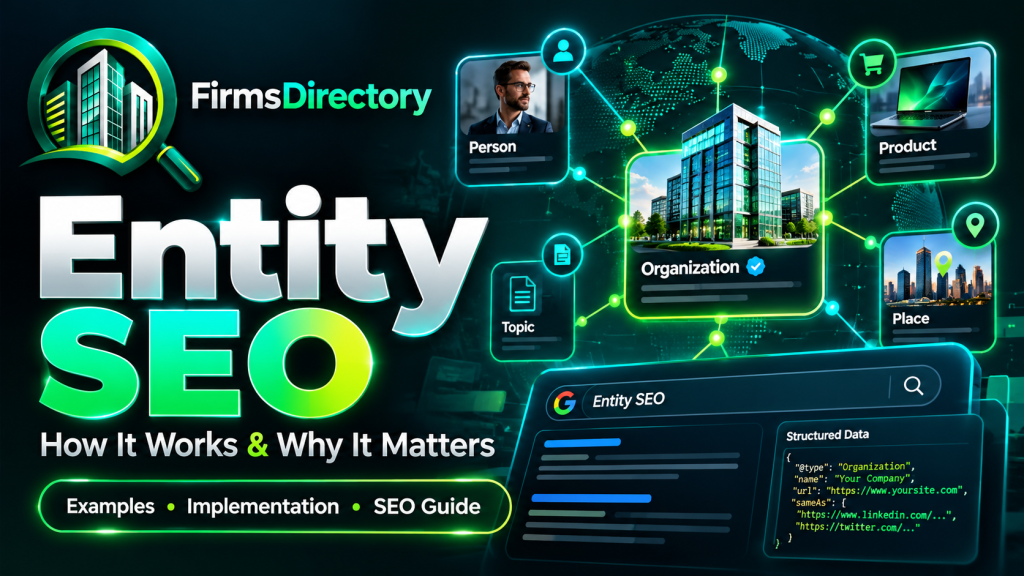
Entity SEO is an approach to search engine optimization that focuses on helping search engines understand identifiable subjects, such as businesses, brands, people, products, and their relationships. Instead of focusing exclusively on matching keywords, Entity SEO emphasizes clear identities, meaningful context, accurate information, and connections between related topics.
Search engines have evolved significantly from their early reliance on keyword matching. Modern search technologies can interpret language, recognize concepts, and distinguish between subjects that share similar names.
For businesses, this creates an important opportunity. A strong online presence is no longer just about mentioning relevant keywords. It also involves making it clear who your company is, what it offers, and how it relates to its industry.
In this comprehensive guide, we explain what an entity is in SEO, how entity-based search works, practical Entity SEO examples, the four commonly recognized types of SEO, and how businesses can implement an effective Entity SEO strategy.
What Is Entity SEO?
Entity SEO refers to the practice of improving a website’s content and digital presence so search engines can more accurately identify the people, organizations, products, services, and concepts associated with it.
Traditional keyword-focused SEO often emphasizes specific phrases that users enter into search engines.
Entity-focused optimization adds another layer by emphasizing the meaning behind those phrases and their relationship to identifiable subjects.
For example, consider the phrase “Apple.”
Depending on the context, a user might be searching for the technology company, the fruit, a product made by the technology company, or information about the company’s history.
A search engine needs to interpret the context to determine which meaning is relevant.
Entity-based search helps address this challenge by recognizing that different subjects can share the same word or name.
In business SEO, this means improving the information that connects a company’s name to its official website, services, products, and other relevant business details.
The goal of Entity SEO is to reduce ambiguity and make a business easier to understand within the broader context of the web.
Entity SEO is an industry term rather than a separate, officially published Google ranking system. There is no single Entity SEO score that guarantees search visibility.
What Is an Entity in SEO?
An entity in SEO is a distinct and identifiable subject that a search system can potentially recognize and distinguish from other subjects.
An entity can represent a person, company, brand, product, organization, place, event, or concept.
Unlike a keyword, which is a word or phrase, an entity represents the underlying subject that the keyword may refer to.
Understanding Keywords and Entities
Consider the keyword “Microsoft.”
The word itself is a search term. However, the entity Microsoft represents a specific technology organization associated with products, services, and business activities.
Search engines may connect the organization with relevant entities, including its products and related technologies.
For example:
- Microsoft is an organization.
- Microsoft 365 is a product family.
- Microsoft Word is a software product.
- Word processing is a software category.
These are different but related subjects.
The relationships help explain what Microsoft offers and how its products relate to broader technology concepts.
Why Identifying Entities Is Important
Search engines must deal with ambiguous words, similar company names, and different ways of referring to the same subject.
Entity recognition can help systems interpret searches more accurately.
For example, a query about a software company’s founder has a different intent from a query about its software products.
Understanding the relevant entity and its relationships can help search systems identify information that is more useful to the searcher.
What Is an Entity? Examples Explained
Entities exist across many industries and subjects. They are not limited to large corporations or famous individuals.
The following examples illustrate different types of entities commonly discussed in search optimization.
| Entity Type | Example | Related Information |
|---|---|---|
| Organization | Microsoft | Software, cloud computing, technology products |
| Person | Bill Gates | Entrepreneur, Microsoft co-founder |
| Product | Microsoft Word | Word processing software |
| Brand | Samsung | Consumer electronics and technology products |
| Concept | Search Engine Optimization | Search visibility and website optimization |
| Event | Consumer Electronics Show | Technology industry exhibition |
Business Entity SEO Example
Imagine a fictional software company named NimbusFlow that develops customer relationship management applications.
Its official website explains that NimbusFlow offers CRM software, contact management, sales pipeline tools, and customer communication features.
The company is associated with several relevant subjects:
- NimbusFlow: The organization
- NimbusFlow CRM: The software product
- Customer relationship management: The software category
- Sales pipeline tracking: A product capability
- Small businesses: An intended customer segment
These connections provide meaningful context about what the organization does.
Instead of repeatedly using the phrase “best CRM software,” the company can explain its actual product features and how they address customer needs.
This approach creates clearer information for both visitors and search systems.
How Does Entity SEO Work?
Entity SEO works by improving the clarity, accuracy, and relationships of information associated with a specific subject.
Modern search systems analyze webpages, links, structured data, and other available information to understand what pages discuss and how subjects are connected.
Google’s Knowledge Graph is one example of technology designed to organize factual information about identifiable subjects and their relationships.
However, Google’s internal systems are complex, and Entity SEO should not be interpreted as a simple process of submitting information directly into a universal database.
1. Entity Recognition
A search system first needs to identify the subject being discussed.
For example, a webpage describing Microsoft Teams provides information about a particular software product rather than collaboration software in general.
2. Entity Disambiguation
Disambiguation means distinguishing between subjects that have similar names or multiple possible meanings.
A clear company identity, official website, and descriptive content can help reduce ambiguity.
3. Relationship Understanding
Search systems can use information about relationships to better interpret content.
For example, a software company may develop several products that belong to different business software categories.
Explaining these relationships helps readers understand how the organization and its products fit together.
4. Information Corroboration
Search systems may encounter information about the same organization across different sources.
Accurate public business information can help clarify identity, although repeated mentions alone do not guarantee trust, rankings, or inclusion in a knowledge graph.
5. Contextual Relevance
When a user searches for a particular topic, the search system attempts to identify useful information related to the intended subject.
A webpage describing a company’s actual services may be more relevant to a specific search than a generic page that simply repeats popular keywords.
Entity SEO vs. Keyword SEO: What’s the Difference?
Keyword SEO and Entity SEO are complementary approaches.
Keyword-focused optimization considers the words people use when searching.
Entity-focused optimization emphasizes what those words refer to and how the relevant subjects relate to one another.
| Factor | Keyword SEO | Entity SEO |
|---|---|---|
| Primary Focus | Search phrases and terminology | Identifiable subjects and relationships |
| Content Strategy | Relevant search terms and intent | Clear definitions, context, and subject coverage |
| Business Identity | Relevant brand searches | Consistent information about the organization |
| Technical Support | Titles, headings, crawlability | Appropriate structured data and clear relationships |
| Best Practice | Answer relevant searches | Explain relevant subjects accurately |
Businesses do not need to choose one approach over the other.
A strong educational article can target relevant keywords while clearly explaining the entities and concepts behind them.
For example, an article targeting “CRM software for small businesses” can also explain customer relationship management, contact management, lead tracking, and sales automation.
This improves the depth and usefulness of the article without unnecessary keyword repetition.
Why Entity SEO Matters for Businesses
Entity SEO matters because clear business information helps customers and search systems understand what an organization represents.
Improves Business Identity Clarity
A company with accurate and consistent public information may be easier to distinguish from organizations with similar names.
Supports More Relevant Content
Entity-focused content encourages businesses to explain their services, products, and related concepts in meaningful detail.
Complements Traditional Search Optimization
Entity SEO works alongside technical SEO, content quality, and website organization rather than replacing them.
Helps Customers Understand Your Expertise
Businesses that explain their actual capabilities clearly can help potential customers determine whether their services match specific needs.
Creates Useful Context for AI Search
AI-powered search systems can retrieve and interpret information from different online sources.
Clear information about an organization’s identity, products, and services may be useful in these retrieval processes.
However, clear entity information does not guarantee AI-generated recommendations or citations.
What Are the Four Types of SEO?
Four commonly discussed types of search engine optimization are on-page SEO, off-page SEO, technical SEO, and local SEO.
This is a practical industry classification rather than a universal official taxonomy. Other classifications may include ecommerce SEO, international SEO, and additional specialties.
1. On-Page SEO
On-page SEO focuses on optimizing content and elements within individual webpages.
Examples include descriptive page titles, useful headings, accurate content, readable URLs, and relevant internal links.
Entity SEO complements on-page SEO by encouraging content that clearly identifies and explains important subjects.
2. Off-Page SEO
Off-page SEO involves activities and information outside a website that can contribute to its online discovery and reputation.
Examples include editorial links, media coverage, independent references, and legitimate business listings.
Accurate third-party information may help customers recognize and research a business.
However, off-page mentions should not be manufactured solely to manipulate rankings.
3. Technical SEO
Technical SEO focuses on ensuring that search engines can access, crawl, and interpret important website content.
Important practices include maintaining indexable pages, resolving technical errors, improving website usability, and implementing appropriate structured data.
Entity-focused information can benefit from structured data when the markup correctly describes the page.
4. Local SEO
Local SEO focuses on improving a business’s visibility for searches involving geographic intent, such as finding a nearby provider.
Businesses with physical locations may use accurate contact information, appropriate business profiles, and relevant local content.
Entity SEO can complement local SEO by helping distinguish a particular organization from other businesses with similar names.
Where Does Entity SEO Fit?
Entity SEO is not limited to one of these four categories.
It can involve on-page content, off-page references, structured data, and business identity information.
Rather than thinking of Entity SEO as a replacement for the four types of SEO, it is more useful to treat it as an approach that complements several optimization practices.
What Is Entity SEO and How Do I Implement It?
Implementing Entity SEO involves making an organization’s identity and related information clear, accurate, and accessible.
The following steps provide a practical framework for business owners and website managers.
Step 1: Define Your Primary Business Entity
Start by documenting the basic identity of your organization.
Identify its official name, primary website, core services, important products, and recognizable brand information.
This information should be accurate and consistent across the company’s own website.
Step 2: Build a Clear About Us Page
An informative About Us page can explain who operates the business, what the organization does, and its main areas of activity.
Where appropriate, include factual information about the company’s history, products, team, and business operations.
Avoid unsupported claims about being the largest, most trusted, or best company in an industry.
Step 3: Identify Related Topics and Entities
Determine which subjects are genuinely related to the company’s services.
For example, a company developing accounting software may cover topics such as:
- Accounting software
- Invoice processing
- Expense tracking
- Financial reporting
- Bookkeeping automation
These subjects can help explain the company’s expertise and product capabilities.
Only include topics that are relevant to its actual offerings.
Step 4: Create Helpful Topic-Based Content
Develop educational articles that answer questions about the company’s industry and services.
For example, an accounting software provider could publish an article explaining how automated invoice processing works.
Another article might compare different expense management methods.
Each article should provide useful information rather than repeat the same keywords in slightly different ways.
Step 5: Improve Internal Linking
Connect relevant pages using descriptive internal links.
For example, an educational article about customer management can link naturally to a product page explaining a company’s CRM software.
Internal links help visitors navigate between related resources and allow search engines to discover connected pages.
Step 6: Implement Appropriate Structured Data
Structured data provides standardized descriptions of webpage information.
For example, Schema.org’s Organization type can describe an organization and its official website.
The sameAs property can identify authoritative external profiles or reference pages representing the same organization.
Structured data must accurately describe the corresponding subject. Do not add unrelated company names, fake profiles, or unsupported relationships.
Google recommends providing Organization structured data on a homepage or another appropriate page describing the organization.
Adding structured data does not guarantee a Knowledge Panel or improved rankings.
Step 7: Maintain Accurate Third-Party Profiles
Review public profiles representing the business on relevant directories and other platforms.
Ensure the name, website, and business descriptions identify the same organization accurately.
Business directories can provide another legitimate destination where people research companies.
For example, business owners can explore company profiles on FirmsDirectory to understand how business information is organized by industry.
Step 8: Use Descriptive Titles and Headings
Titles and headings should explain the main subject of each webpage.
For example, “Invoice Automation Software for Businesses” is more informative than a vague heading such as “Our Amazing Solution.”
Good headings should reflect the real content of the page and help readers find information quickly.
Step 9: Keep Information Updated
Business information changes over time.
Companies may introduce new products, discontinue services, rebrand, or update their official websites.
Review public information periodically and correct inaccuracies whenever possible.
Step 10: Monitor Search Performance
Use Google Search Console and other appropriate tools to understand which pages are indexed, which search queries generate impressions, and how visitors discover the website.
Compare performance over time and evaluate whether improvements are producing meaningful results.
There is no universally accepted metric that directly measures an organization’s complete Entity SEO strength.
Practical Entity SEO Example: A Software Company
Consider the fictional software company NimbusFlow introduced earlier.
NimbusFlow provides customer relationship management software for small businesses.
Before Entity-Focused Optimization
Its website contains a homepage with generic statements such as:
“We provide innovative solutions to help modern businesses succeed.”
The website does not explain its software features, intended customers, or how its services work.
As a result, visitors may struggle to understand what the company actually offers.
After Entity-Focused Optimization
NimbusFlow updates its website with a detailed company description:
“NimbusFlow develops customer relationship management software that helps small businesses organize customer contacts, manage sales pipelines, track leads, and coordinate customer communications.”
The company also creates dedicated pages about lead tracking, CRM workflows, and customer management.
Its About Us page accurately identifies the organization, and its product pages explain the relationship between the company and its software.
Relevant pages are connected using descriptive internal links.
Appropriate structured data is added where it accurately represents the content.
The company also maintains accurate profiles on relevant third-party platforms.
What Improved?
The company now provides clearer information about its identity, products, and related services.
Visitors can more easily determine whether NimbusFlow is relevant to their needs.
Search engines also have more explicit information available to interpret.
However, these improvements do not automatically establish a ranking increase or inclusion in Google’s Knowledge Graph.
The example illustrates how Entity SEO can improve informational clarity while supporting wider SEO practices.
How Business Directories Can Support Entity SEO
Business directories can contribute to an organization’s public digital presence by creating additional pages containing company information.
A useful directory profile can identify a business, explain its services, and direct interested visitors to its official website.
These profiles may help potential customers discover relevant companies while researching products or services.
Business Identity Information
A company profile can display the organization’s official name, business description, and website.
This information can provide context about the business and help visitors understand its activities.
Industry Associations
Relevant categories can connect a business with the industries or services it actually provides.
For example, a company developing cloud-based CRM software may be categorized within the software industry.
Accurate categorization is more valuable to users than placing a company into unrelated categories simply to increase exposure.
Publicly Accessible Information
Search engines and AI-powered retrieval systems can encounter publicly accessible webpages, including relevant business directory profiles.
However, discoverability does not guarantee that the information will be indexed, used, or cited.
Company Verification
Some business directories offer verification processes to help establish that a user controls or represents a business.
Verification may improve confidence within the directory’s own platform, but it does not automatically mean that Google or another search engine considers the company authoritative.
Using FirmsDirectory for Business Discovery
FirmsDirectory is an online platform for discovering companies through business profiles and industry categories.
For businesses developing an Entity SEO strategy, maintaining an accurate profile on a relevant directory can complement their official website and broader digital presence.
Businesses can explore the business directory or submit their website to FirmsDirectory.
A directory listing should be treated as an additional business discovery resource, not as a guaranteed ranking technique.
How Entity SEO Relates to AI Search, AEO, and GEO
The growth of AI-powered search has increased interest in how search systems interpret organizations, products, and related subjects.
Answer Engine Optimization (AEO) focuses on presenting useful information that can directly answer questions.
Generative Engine Optimization (GEO) is an industry term describing efforts to improve visibility within AI-generated search responses.
Entity SEO overlaps with these approaches because clear information about identifiable subjects can be useful in search and retrieval systems.
Example: AI Business Recommendation
Imagine a person asking an AI-powered search assistant:
“What CRM platforms are designed for small businesses?”
A search-enabled AI system may retrieve information about companies and products that match the question.
A website clearly describing its CRM software, relevant product features, and intended customers may contain useful information for that research.
Other public resources, such as business directories and independent comparisons, may also be relevant.
Nevertheless, an AI platform’s choice of companies and sources depends on its own retrieval and response-generation processes.
Entity SEO can support clearer machine-readable and human-readable information, but it does not guarantee inclusion in AI recommendations.
Common Entity SEO Mistakes to Avoid
1. Treating Entity SEO as Keyword Stuffing
Repeating company names and related terms excessively does not automatically improve entity recognition.
Focus on accurate descriptions and useful explanations instead.
2. Creating False Relationships
Do not claim that a company is officially associated with another organization or product unless that relationship is accurate.
3. Using Incorrect Structured Data
Schema markup should describe the content and entities represented on the actual webpage.
Adding unrelated entities or inaccurate properties can misrepresent the page.
4. Ignoring the Official Website
Third-party profiles are useful additions, but businesses should maintain accurate information on their own websites.
5. Creating Duplicate, Low-Value Pages
Publishing hundreds of nearly identical pages about minor keyword variations does not necessarily improve topical relevance.
Concentrate on useful information that answers genuine customer questions.
6. Assuming a Knowledge Panel Is Guaranteed
Google’s Knowledge Graph uses information from various sources.
Structured data and public company information can help clarify identity, but no individual SEO technique guarantees a Knowledge Panel.
How to Measure Entity SEO Results
Entity SEO performance cannot be fully summarized by one score.
Instead, website owners should examine several practical indicators.
Branded Search Visibility
Monitor searches involving the company name, products, and relevant brand terminology.
Look for improvements in the visibility and usefulness of official webpages.
Organic Search Performance
Use Google Search Console to track clicks, impressions, and queries associated with relevant pages.
Content Discoverability
Review whether important pages about products and services are indexed and accessible.
Information Accuracy
Check whether the company’s website and important public profiles contain consistent and correct information.
Qualified Business Outcomes
Monitor meaningful results such as qualified inquiries, registrations, and customer engagement.
These outcomes provide more practical business value than focusing exclusively on branded mentions or theoretical entity scores.
Changes in search performance may result from many factors, so avoid attributing every improvement to a single Entity SEO change.
Frequently Asked Questions About Entity SEO
What is an entity in SEO?
An entity in SEO is a distinct, identifiable subject such as a person, organization, product, brand, place, or concept. Search systems can use information about entities and their relationships to interpret content and search queries.
What are four types of SEO?
Four commonly recognized types of SEO are on-page SEO, off-page SEO, technical SEO, and local SEO. Entity SEO can complement several of these approaches by improving the clarity of information about businesses and related subjects.
What is an entity and example?
An entity is an identifiable subject. For example, Microsoft is an organization entity, Microsoft Word is a software product, and word processing is a related concept. These subjects are distinct but connected.
What is Entity SEO and how do I implement it?
Entity SEO focuses on making identifiable subjects and their relationships clear to search systems. Businesses can implement it by maintaining accurate company information, creating useful content, organizing related topics, using descriptive internal links, implementing appropriate structured data, and maintaining legitimate public profiles.
What is an Entity SEO example?
A software company can improve its entity-focused information by clearly identifying its organization, explaining its products, describing their features, linking related pages, and maintaining accurate business profiles. This provides context about the company and its offerings.
What is Entity SEO, how does it work, and why does it matter?
Entity SEO emphasizes identifiable subjects rather than relying exclusively on keyword matching. It works by improving information about entities, their identities, and their relationships. It matters because clear information helps users understand businesses and can support search engines in interpreting relevant content.
Is Entity SEO more important than keywords?
Entity SEO and keyword optimization are complementary. Keywords help identify what users search for, while entity-focused optimization emphasizes the meaning and context of those subjects. Effective SEO usually considers both.
Does Entity SEO help with AI search?
Clear entity information may be useful to AI-powered search systems that retrieve and interpret public webpages. However, implementing Entity SEO does not guarantee mentions, citations, or recommendations in AI-generated answers.
Can business directories support Entity SEO?
Relevant business directories can provide additional publicly accessible information about companies, their industries, and their official websites. Accurate directory profiles can complement a company’s broader online presence, although directory listings do not guarantee improved rankings.
Does Organization schema guarantee a Google Knowledge Panel?
No. Organization structured data can help Google understand information about an organization, but it does not guarantee that Google will display a Knowledge Panel or improve the website’s rankings.
Conclusion: Build a Clear Business Identity with Entity SEO
Entity SEO reflects an important aspect of modern search optimization: search systems must understand what webpages discuss, not simply identify repeated keywords.
For businesses, this means making company information accurate, accessible, and easy to interpret.
A practical Entity SEO strategy includes informative company descriptions, relevant educational content, well-organized website pages, appropriate structured data, and accurate public profiles.
These practices can complement traditional SEO, Answer Engine Optimization, and Generative Engine Optimization.
However, businesses should avoid promises of guaranteed search rankings, Knowledge Panels, or AI recommendations.
The strongest long-term approach is to help visitors and search systems understand who your business is, what it offers, and why its information is relevant.
Businesses interested in creating an additional public profile can visit FirmsDirectory and explore its company discovery platform.